As-code, always
Every lakehouse ships from the Leverage reference architecture — reviewable, versioned, repeatable. OpenTofu first, Terraform fully supported.
AWS Data Platforms
Lakehouses, pipelines and warehouses on AWS — governed, portable, and ready for the agents that read them.
WHAT IT IS
Most teams do not have a data problem. They have six, in six systems, with no single answer to “what is actually true?”
What we do
For Ximple, S3 is zoned raw, processed and curated — Parquet with Snappy, tied together by a Glue Data Catalog. InstaCrops needed the same foundation under its own names — Raw-Bronze, Silver, Gold — which binbash designed as an advisory engagement: the client’s own engineers built it.
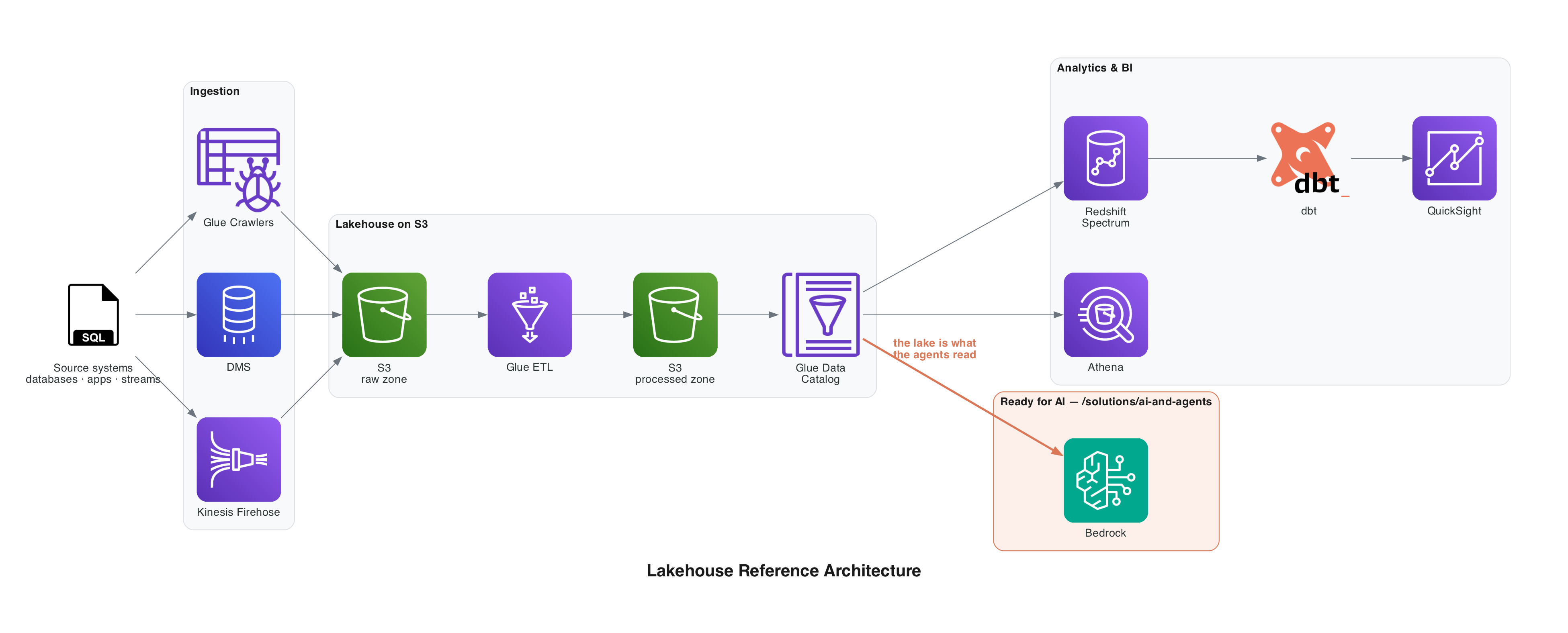
For Ximple, ingestion runs on Glue Crawlers and Glue-plus-DMS pipelines, with DynamoDB Streams feeding Firehose for change-data-capture loads. Celes’s ingestion crosses clouds entirely: a DataSync agent moves data from GCP into AWS.
For Ximple, Redshift Spectrum queries S3 directly through an external Glue catalog, with materialized views on top. Vistapath runs on Redshift Serverless. Celes stays portable across clouds, so its warehouse is StarRocks on EKS — open source, no lock-in.
Vistapath’s dbt models run on Redshift into QuickSight dashboards templated as infrastructure-as-code — a change ships as a pull request, not a ticket to a data team.
Vistapath’s pipeline starts once PHI is stripped: SageMaker endpoints de-duplicate and segment images, with pgvector on RDS Postgres holding the vectors. SQS feeds an EventBridge Pipe into Step Functions, routing each image to instalabel.ai for annotation. A Glue ETL job turns the finished annotations into tabular data the warehouse can serve.
Celes’s cross-provider lake — Hudi on S3, StarRocks on EKS — is watched end to end: Prometheus and Grafana for metrics, OpenSearch and FluentBit for logs. KEDA scales to zero between jobs, and OpenBao holds the secrets.
Vistapath strips PHI in a production-account Lambda before any of it reaches the data-science account. Akua keeps PII and non-PII in separate buckets and separate accounts, least-privilege throughout — including the Glue Data Catalog and Athena tables the cleaned results land in.
How we do it
Every lakehouse ships from the Leverage reference architecture — reviewable, versioned, repeatable. OpenTofu first, Terraform fully supported.
Open formats on S3 — Parquet, Hudi — with StarRocks as the warehouse. No lock-in, so you can leave whenever you want.
PHI, PII and KYB data stays isolated, encrypted and least-privilege from day one — never bolted on afterwards.
AWS funding programs backed four of these five engagements, one of them in full. The fifth — Vistapath’s computer-vision pipeline — ran through AWS Partner Network, reviewed and approved by an AWS Solutions Architect.
Leverage is the reference architecture that lands your AWS foundation — and the same one that builds and runs the data platform on top of it, from account baseline to lakehouse, as code.
Sources land in S3, get curated once, and are served to Athena, Redshift Spectrum and the agents that read it.
PROOF
10+
Lakehouse foundations, ingestion pipelines, data warehouses, computer-vision pipelines and governed catalogs. Ximple, Celes, Vistapath, InstaCrops and Akua are among the clients.
5
A client data platform delivered in each.
5
Data warehouse, data lake, data lakehouse, data pipelines and computer-vision data pipelines — the shapes we build, each one delivered for a named client.
Let’s architect a lakehouse that scales with you.